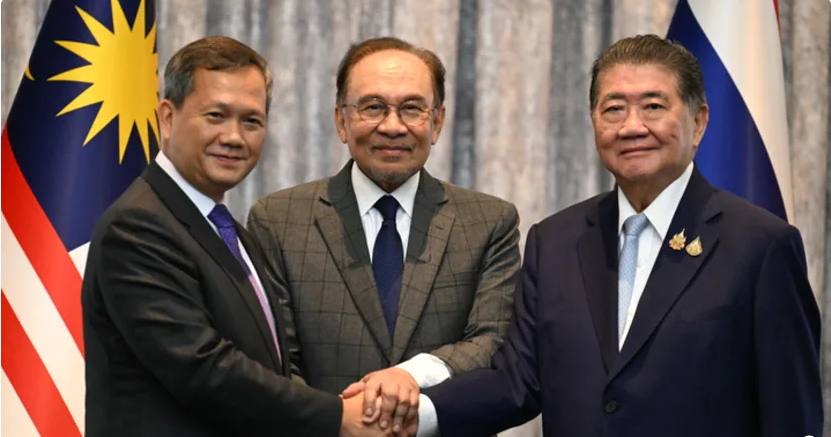
(Left to right) Cambodia’s Prime Minister Hun Manet, Malaysia’s Prime Minister Anwar Ibrahim and Thailand’s acting Prime Minister Phumtham Wechayachai shake hands after ceasefire talks on Jul 28, 2025. (Photo: Pool via AFP/Mohd Rasfan)
KUALA LUMPUR: In politics, as in opera, nothing is over till the fat lady sings. Perhaps no one knows this better than seasoned politician and Malaysia’s Prime Minister Anwar Ibrahim.
The Anwar administration has been under both internal and external pressure. Controversy surrounded the government’s failure to fill vacancies in the country’s highest courts, triggering allegations last month that Mr Anwar was interfering with the judiciary.
Hundreds of lawyers thronged the streets of Putrajaya in protest, walking under the midday sun to hand over a memorandum calling for action, transparency and a Royal Commission of Inquiry.
On Jul 1, Malaysia expanded its sales and services tax (SST) to more categories of goods and services. Though selective, the changes created public uproar and ammunition for the opposition to use against Mr Anwar’s administration.
Also in early July, the US raised Malaysia’s tariff rate by 1 percentage point to 25 per cent, even after Putrajaya’s efforts to negotiate with Washington.
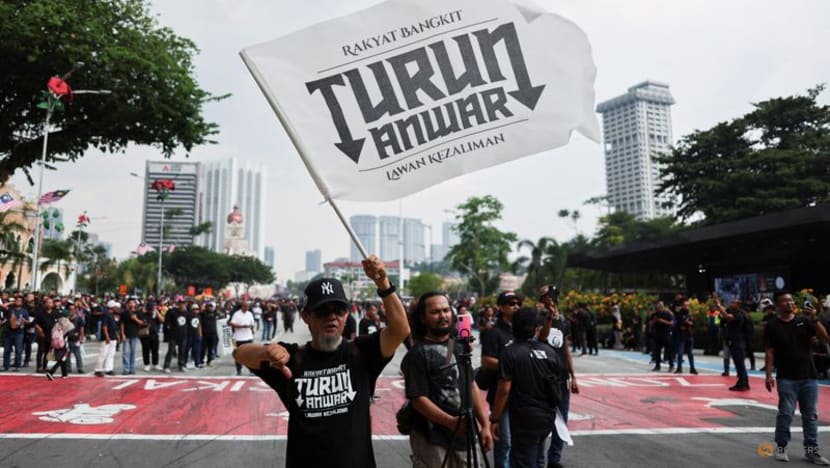
Sensing an opening, 100-year-old former prime minister Mahathir Mohamad went for the jugular, calling for Mr Anwar to step down. The opposition coalition, Perikatan Nasional, capitalised on this wave of dissatisfaction by organising the “Turun Anwar” (Step Down Anwar) rally on Jul 26.
Meanwhile, long-simmering tensions between Cambodia and Thailand escalated when the two countries exchanged fire, putting Malaysia’s ASEAN chairmanship to the test. Murphy’s Law ran in full: Anything that can go wrong, will go wrong.
But the story did not fully play out until the eleventh hour.
ANWAR’S TRUMP CARD
The appointments of neutral candidates to the top judicial posts, including former deputy minister Wan Ahmad Farid Wan Salleh, did enough to quell dissent, though questions on judicial independence remained.
On the economic front, the Anwar administration rolled out measures to support citizens, such as a one-off RM100 (US$24) cash handout to all adult Malaysians and an additional public holiday.
While the reactions to these measures were at best mixed, the lukewarm Turun Anwar rally ended up making Mr Anwar look better. Turnout was significantly lower than what a few opposition lawmakers predicted, and it was concentrated among the opposition’s Malay supporters. Without broad-based support, a protest might prove counterproductive to the organisers.
The trump card for Mr Anwar, however, was his role in mediating the Cambodia-Thailand conflict. The prime ministers of the two countries convened in Malaysia and signed an unconditional ceasefire agreement, after five days of fighting.
Isolated skirmishes continued the next day, with both countries accusing the other of flagrant violations. But regional military commanders came together to maintain the ceasefire deal. Defence attaches agreed to meet in Malaysia, and direct communication lines were established in August. Displaced civilians began returning home. In the end, the ceasefire held.