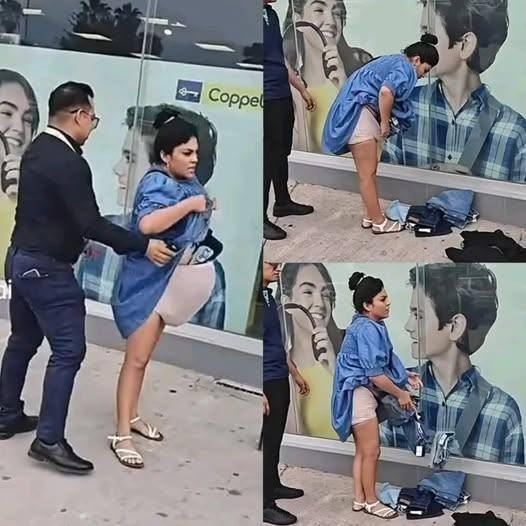
Saltillo, Coahuila – A woman faked a baby bump to steal from a department store in Saltillo, Coahuila . The video showing the moment she was arrested for stealing several items and hiding them under her clothes has gone viral on social media since April 29, when it began circulating online.

This incident occurred at the Coppel store in that city. The images released show the woman wearing a loose-fitting blue dress with several items of clothing hidden underneath, stealing them in an unusual manner. The viral footage was accompanied by the caption: “Oh my gosh, now Coppel women are getting pregnant.”
In the audiovisual material, the woman is seen crossing her arms, visibly upset after being surprised outside the store by the employees, and lifting her dress to take out the clothes that had been hidden to simulate a pregnant belly, at the same time that the employees gather around and one of them makes a phone call, although it is unknown if it was to the authorities, according to infobae .
Through Tik Tok and X formerly Twitter , this video had several views in which the store’s security personnel are seen confronting the woman who initially denied stealing the clothes, but when she saw herself cornered by several people, who also began to record the event, she agreed to take them out, at least 10 pairs of jeans were rolled up and several perfectly arranged t-shirts.
This type of technique used by women is known as ” farderismo” and is an illicit practice of hiding items among clothing to steal them without paying. The release of the video has sparked debate among users about the incident and highlighted attempted theft in commercial establishments, although the legal consequences or the actions taken by this store are unknown.
However, it is a reminder that today, any action taken in the digital age is recorded and shared within minutes, exposing those involved to millions of people around the world.
According to a study by the Autonomous University of Coahuila (UAC) , petty theft of merchandise is practiced occasionally or systematically by employees, suppliers, and customers within the company, and even if it involves small quantities of products, it can cause greater losses for companies in the long term.
The National Business Victimization Survey , conducted by INEGI , reveals that 78.3% of business theft offenses go unreported, meaning 8 out of 10 go unpunished.
The story of a woman who went viral on social media for faking pregnancy to steal from a store is both shocking and thought-provoking. The incident, captured in photographs and short video clips, quickly spread online, sparking conversations about crime, desperation, and the extremes people sometimes go to in order to deceive. In the images, the woman can be seen wearing an oversized blue shirt with a large, rounded belly that initially gave the impression of pregnancy. However, as store personnel intervened, it became clear that the bulge was not the result of an unborn child but of stolen clothes hidden under her attire.
The act itself is remarkable because of its creativity and brazenness. Faking a pregnancy to shoplift is not a common tactic, and the spectacle of pulling numerous garments from under her shirt shocked viewers. Many users across social platforms expressed disbelief, commenting that the situation looked like a scene out of a movie rather than real life. Yet, it underscores a pressing reality: theft in retail stores remains a global challenge, and people continue to invent new methods to try to outsmart security systems.
Going viral has amplified the incident far beyond the local store. Millions of people who may never have witnessed such an act in person were able to see and discuss it online. This raises questions about the role of social media in shaping public perception of crime. On one hand, viral exposure can deter others from committing similar acts by highlighting the humiliation and consequences of getting caught. On the other hand, it also runs the risk of turning crime into a spectacle, where the individual involved becomes the subject of ridicule and memes, rather than a person whose actions might be rooted in desperation or poor decision-making.
From a sociological perspective, incidents like this often reveal underlying issues. Why would someone resort to such lengths to steal clothes? Was it driven by poverty, personal greed, or a lack of awareness of the consequences? For some, shoplifting can be a symptom of economic hardship, where basic needs are unmet, leading individuals to desperate measures. For others, it can be an impulsive act or even a habitual behavior. Regardless of motive, the imagery of a woman pretending to be pregnant for theft struck a nerve with audiences because it manipulates a universally respected and sensitive symbol—motherhood.
The public’s reaction has been mixed. Some expressed anger and condemnation, arguing that her actions damaged the reputation of honest women and exploited the image of pregnancy in an unethical way. Others took a more sympathetic stance, suggesting that society should address the root causes of why people feel compelled to steal rather than simply ridicule or punish them. What is undeniable is that the internet magnified her actions, ensuring she will be remembered more for this incident than for anything else.
Ultimately, this viral moment is a lesson in both human behavior and the power of technology. It shows how quickly an isolated act of theft can become a global talking point, and how deception—no matter how creative—rarely goes unnoticed. It also challenges communities to reflect on the balance between holding individuals accountable and understanding the social conditions that may drive such desperate acts.
Would you like me to frame this in a neutral news report style or a more dramatic storytelling style for maximum reader engagement?