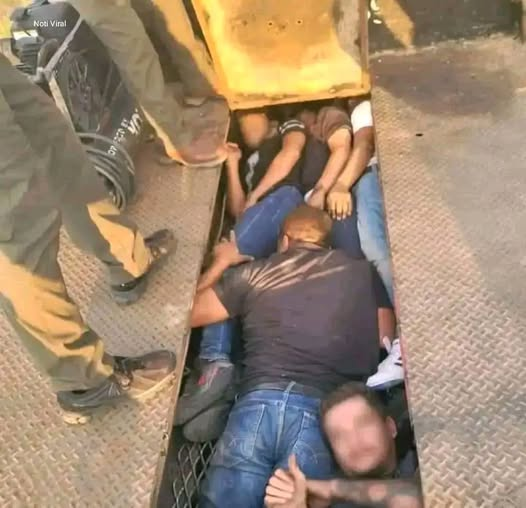
The image depicts a deeply distressing scene that highlights the desperate measures people sometimes take in pursuit of safety, opportunity, or survival. Several individuals are seen crammed into a narrow, concealed compartment beneath what appears to be the metal floor of a transport vehicle. The confined space, clearly not meant for human occupancy, underscores the severity of their circumstances and the extreme risks they are willing to endure. Around the hidden compartment, law enforcement officers stand, suggesting that this is a moment of discovery — a likely interception of an illegal transport operation, perhaps related to human smuggling or trafficking.
The visual impact of the image is powerful and unsettling. The people inside the compartment are pressed tightly against one another, with no room to move or breathe comfortably. The lighting and composition amplify the tension — the metallic surroundings and the dim shadows evoke a sense of claustrophobia and fear. This is not just a physical confinement but a representation of how vulnerable individuals become when caught between hope and desperation. Their faces, blurred for anonymity, further emphasize the loss of identity and dignity that accompanies such situations. They are not portrayed as criminals, but as victims of circumstance, trapped in a system that leaves them with no safe or legal path forward.
Scenes like this one are often linked to migration crises that occur across the world — whether along the U.S.-Mexico border, the Mediterranean Sea, or other transit zones where people flee poverty, violence, or persecution. Smugglers exploit this desperation, charging exorbitant sums to move people under horrific and often deadly conditions. Each journey becomes a gamble with fate, where suffocation, dehydration, or discovery by authorities are constant dangers. The hidden compartment in this image is a grim testament to how human life is devalued in these networks, reduced to cargo to be hidden away.
The involvement of law enforcement introduces another layer of complexity. On one hand, officers have the duty to enforce immigration and safety laws; on the other, they are witnesses to the human suffering those laws sometimes fail to alleviate. The discovery of such hidden compartments can save lives by preventing suffocation or injury, yet it also means the detained individuals may face deportation, imprisonment, or renewed danger in their home countries. This moral tension sits at the heart of global migration debates — between sovereignty and compassion, legality and humanity.
Beyond policy and politics, this image compels reflection on the universal human desire for a better life. Each of these individuals likely has a story — of family left behind, of dreams of work, of fear of violence or hunger. Their choice to risk everything for a chance at something better is both heartbreaking and profoundly human. In their silence, one can hear the echo of millions displaced by war, inequality, and environmental collapse.
Ultimately, this photograph is a stark reminder that migration is not a statistic; it is a human experience, often marked by pain, courage, and hope. The hidden compartment may symbolize concealment, but it also exposes an undeniable truth: as long as injustice and desperation persist, people will continue to seek freedom, even in the darkest and narrowest of places.