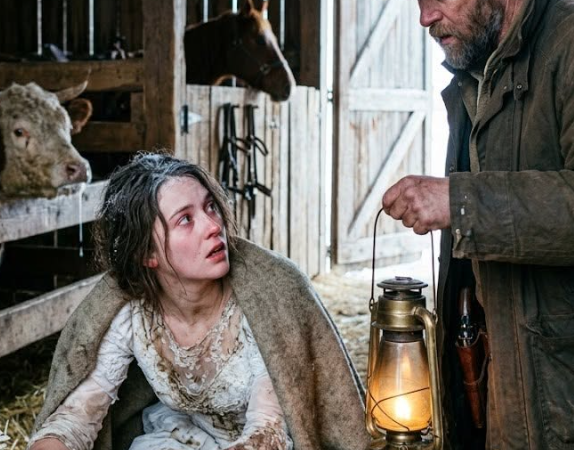
A Runaway Bride Collapsed at His Barn Door — Then She Saw What Was Killing His Herd
The first thing Jedediah Hayes saw through the blowing snow was the wedding dress.
Not white anymore.
Mud had dragged through the hem. Ice had stiffened the silk until it cracked when the woman moved. The lace at her sleeves was torn, and her scraped hands hit his barn door with a sound too weak to be a knock and too desperate to be the wind.
The Montana blizzard had already swallowed the fence line, the woodpile, and half the corral. It hissed under the barn eaves and shoved cold through every split board, carrying the smell of wet wool, hay dust, and sick cattle.
Jedediah drew his revolver before he raised the lantern.
Out here, a shape in a storm could be a ghost, a thief, or trouble riding ahead of worse trouble. He had lived alone in that high pass for five hard years, long enough to know mercy could get a man killed if he did not look twice.
Then the woman’s eyes opened.
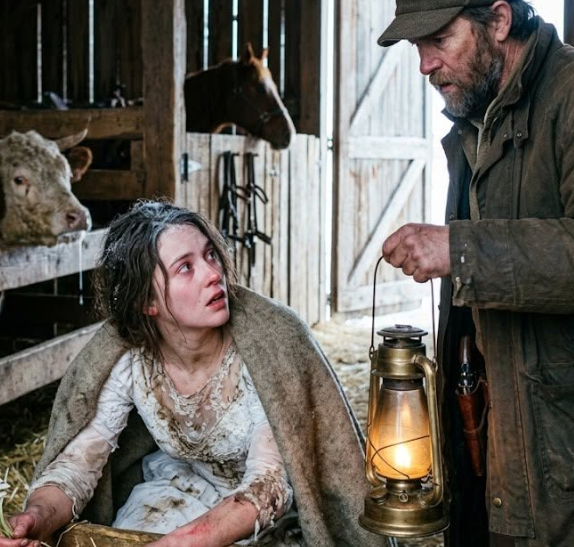
Hazel. Terrified. Alive.
He holstered the gun and lifted her off the frozen threshold like she weighed no more than wet lace. Her head fell against his coat, and the cold coming off her dress soaked through his sleeve before he had taken three steps.
Inside the barn, the cattle groaned from the stalls.
Thirty head.
That number sat in Jedediah’s chest like a stone because those animals were everything he owned, everything he had bled for, everything he had built since he came up into the mountains with a rifle, a pack mule, and a stubborn refusal to die poor. Now his best steers were trembling on their legs, foam at their mouths, eyes rolling white in the lantern glow.
Winter had a way of collecting debts from men who thought they were strong.
But this did not look like winter.
He carried the stranger into the tack room, turned his back, and set a stack of dry wool blankets on the crate beside her. “Get out of that wet silk before the cold finishes what the storm started.”
The woman’s fingers shook so badly she could barely untie the dress. Jedediah kept his eyes on the wall, on the hanging bridles, on the saddle soap tin, on anything but her shame. He had no use for men who looked at fear and called it opportunity.
When she wrapped herself in wool and stepped into the lantern light, he saw the bruises circling both wrists.
Not from falling.
From hands.
She caught him looking and pulled the blanket tighter. “My name is Abigail Thornton,” she whispered. “And I ran from hell.”
He did not ask her to make it pretty.
The story came out in broken pieces while the cattle shifted and groaned behind the wall. Gideon Reed, the cattle baron down in the valley, held her father’s debt. He had not asked for money by the end. He had demanded Abigail instead, dressed as a bride and handed over like a receipt.
She had been standing in that wedding dress when she heard Reed laughing in the next room.
He was not only buying a wife.
He was bragging.
Independent ranchers were soft targets, Reed said. Men with no sons, no backers, and no room for one bad winter. By morning, one mountain man in the high pass would be ruined, and once his herd was dead, the land would follow cheap.
Jedediah went still.
The barn seemed to hear it with him. The stalls quieted for one breath. Even the storm pressed its white face to the boards and listened.
Then one of his best steers groaned so low it shook the tack room wall.
Abigail looked toward the sound, and something in her fear changed. It did not disappear. It hardened.
She pushed the blanket higher around her shoulders and walked toward the sick animal.
“You need rest,” Jedediah said.
“I grew up in a veterinary apothecary,” she snapped, and for the first time, her voice had iron in it. “Show me what they ate.”
He almost told her no. Almost.
A woman half-frozen in a torn wedding dress had no business standing in a poisoned barn at midnight, and a man with thirty dying cattle had no time for hope dressed up as desperation. But her eyes were fixed on the feed, not on herself, and Jedediah had seen enough dying things to know when someone was looking at the right question.
So he led her to the hay bin.
The lantern flame trembled. Hay dust floated through the light. Abigail sank one hand into the feed, then another, moving faster now, ignoring the raw skin across her knuckles and the shiver still working through her body.
She pulled out one clean handful.
Then another.
Then her fingers stopped.
Slowly, Abigail lifted a pale stalk from the hay and turned it under the lantern, her face going whiter than the snow outside.
Jedediah saw the answer before she said the name.
“This isn’t sickness,” she whispered. “This is—”