Part 2: The Shot
Nobody moved.
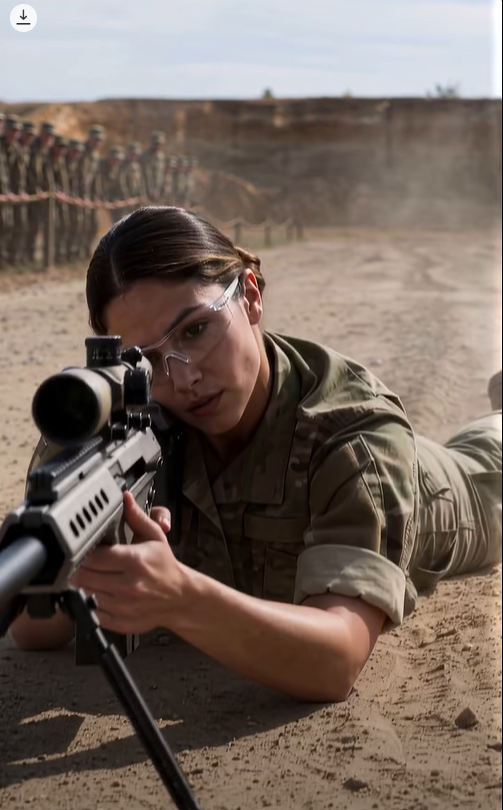
The woman behind the rifle stayed locked into position, cheek pressed to the stock, one eye closed behind the optic.
The range was impossible.
Wind unpredictable.
The target hidden behind shifting obstacles.
And behind her—
the instructors waited.
No one spoke.
The team standing above the firing line had stopped treating this like a training exercise ten minutes ago.
Now they were watching.
The officer in the center folded his arms.
“You have one round.”
She didn’t answer.
She already knew.
The challenge had started an hour earlier.
Every shooter had attempted it.
Every shooter had failed.
Too much distance.
Too many variables.
One missed calculation and the round drifted wide.
The instructors called it The Most Dangerous Shot.
Not because the rifle kicked harder.
Not because the target moved.
Because the moment you pulled the trigger—
you couldn’t correct anything.
Your decisions were already gone.
One breath.
One choice.
Done.
Her spotter leaned closer.
“Wind shifted.”
She nodded.
Small adjustment.
The target was barely visible now.
A steel plate positioned far across broken terrain.
Half-obscured.
Only seconds of visibility at a time.
The spotter whispered:
“Wait.”
She slowed her breathing.
In.
Out.
In.
Her finger rested outside the trigger guard.
Everyone behind her expected the same thing they’d seen all morning.
Someone would get impatient.
Force the shot.
Miss.
But she wasn’t looking at the target anymore.
She was watching the environment.
Dust.
Heat.
Movement.
Tiny clues.
The officer noticed.
“You’re not tracking the plate.”
She didn’t respond.
The spotter looked confused too.
Then she said quietly:
“It isn’t the target moving.”
Nobody understood.
She kept watching.
The rope line.
The grass.
Heat shimmer.
Again.
Again.
Again.
Then she saw it.
The pattern.
The target appeared.
Disappeared.
Appeared.
Always after the same delay.
Not random.
Wind wasn’t changing.
Air wasn’t changing.
Visibility was.
She made two clicks.
The spotter stared.
“What are you doing?”
She said:
“I’m not shooting where it is.”
Another pause.
The target disappeared again.
The officer checked his watch.
“Ten seconds.”
Someone behind him muttered:
“She waited too long.”
Five seconds.
Target hidden.
Three.
Still hidden.
Two.
Nothing.
One—
The target appeared.
She fired instantly.
The sound cracked across the range.
Everyone looked.
The target vanished behind dust.
No reaction.
No sound.
The instructors stayed still.
The officer looked through binoculars.
Silence.
Five seconds.
Then—
CLANG.
The steel rang.
Not center.
But hit.
Nobody moved at first.
Then heads turned.
The spotter looked at her.
“You didn’t even settle.”
She slowly lifted her face from the rifle.
“I already settled.”
The officer lowered the binoculars.
“How?”
She stood.
Calm.
She pointed toward the range.
“You all adjusted for the target.”
Nobody spoke.
She continued.
“The target wasn’t the problem.”
She pointed at the heat waves over the ground.
“The air changed the picture.”
One of the instructors frowned.
“You predicted distortion?”
She shrugged.
“Not predicted.”
She looked downrange.
“Timed it.”
The officer stared at her.
Then gave one short nod.
“Again.”
Someone nearby laughed.
Another trainee whispered:
“She got lucky.”
The officer heard.
He turned.
“No.”
He looked back at her.
“Luck doesn’t fire on the first visible frame.”
The others became quiet.
She started unloading the rifle.
But the officer wasn’t finished.
He walked closer.
“There’s a second phase.”
She looked up.
The spotter frowned.
“There’s what?”
The officer pointed beyond the range.
Past the steel.
Farther.
There was another setup.
Different.
Smaller.
Moving.
She narrowed her eyes.
Vehicle.
Timed movement.
Distance markers.
The officer said:
“This one isn’t about accuracy.”
She looked at him.
He continued:
“It’s about judgment.”
He handed her a small card.
One sentence written on it:
You may fire only if the shot should be taken.
She looked up.
“That’s it?”
He nodded.
No other explanation.
The group followed as she moved to the next station.
New rifle.
New optic.
She got behind it.
Looked through.
Vehicle moving.
Target visible.
Easy shot.
Too easy.
She watched.
Waited.
The vehicle slowed.
Target clearer.
Still didn’t fire.
People behind her shifted.
One instructor asked:
“What are you waiting for?”
She said nothing.
The target turned.
Something changed.
She lowered the rifle.
Stood up.
Officer looked at her.
“Decision?”
She nodded.
“No shot.”
The spotter looked stunned.
“What?”
She handed over the rifle.
The officer asked:
“Explain.”
She pointed.
“Vehicle angle changed.”
Nobody understood.
She continued:
“Backstop disappeared.”
Now the officer smiled.
Small.
Almost invisible.
She kept going.
“Miss risk increased.”
She looked at him.
“Target wasn’t isolated anymore.”
Silence.
One instructor raised binoculars.
Looked.
Stopped.
Then lowered them.
People started realizing.
The officer finally spoke.
“That’s why it’s called the dangerous shot.”
He took the rifle.
“Anyone can hit something.”
He looked at the group.
“The hard part…”
He glanced at her.
“…is knowing when not to.”
Nobody laughed now.
The officer turned back.
“You passed.”
She blinked.
“That was the test?”
He nodded.
He pointed to the empty chamber.
“The first shot measured skill.”
Then toward the second range.
“The second measured discipline.”
The formation stood quietly.
She looked back once at the distant target.
The one she never fired at.
And realized something.
The most dangerous shot—
wasn’t always the hardest one.
Sometimes—
it was the easiest.